
Curtains
Dedicated to Hannah Graham
October 18, 2015
On the First Anniversary of the Discovery of her Remains
In the last years of her life, embroidered on a grey shroud stitched to her sorrowful spirit, my maternal grandmother bore a searing scarlet letter.
In her case, she suffered the shameful A of alcoholism, though Marie Ward herself didn't drink.
I never knew my grandfather, but he did drink. He drank himself to death.
Charles Ward was the Mayor of Nashville, North Carolina, and he had owned a fortune in farm land, planted in cotton, corn, okra, and tomatoes; white, yellow, green, and red, I counted to myself.
My grandmother told me how, farm by farm, they became poor, as Mayor Charlie would sneak out at night to seedier and seedier bars, get obliterated, and gamble.
By the end, "friends" sought out Mayor Charlie for these miserable games. Because he had gone through his cash, he would bring some of the deeds to his property, and put them in the gamblers' pot. He always lost, because he was always drunk, and the other men at the dark tables always cheated him, and split the spoils.
When my mother was named high school valedictorian, her mother was desperate not to let Lillian, her only child, feel ashamed. My grandmother told me that she had to scavenge at night in neighbors' trash cans for scrap fabric with which to sew my mother's "new" valedictory dress.
No wonder Marie Ward so admired my rich paternal grandmother Vance's extravagant home, especially its fabrics.
Her dressing closet held rows of high-heeled silk shoes dyed to match her pastel dresses; her canopied bed was crowned with scalloped drapery; and most impressive: heavy, printed, full-length, swagged-cornice silk curtains hung in every room of her languidly opulent Greensboro mansion.
In 1965, my poor grandmother was with us over the holidays, and came to Christmas dinner at my rich grandmother's.
Mahogany wings inserted, the extended Vance Christmas table winked with chandelier reflections. Southern custom required glistening animals in humped, cooked shapes, flanked by heaps of oily vegetables and steaming biscuits. The compote of gelatinous gravy with its mannerist spoon were the most coveted item to be passed around the table.
I remember Marie Ward and I inadvertently stopped the flow of the gravy dish because she was whispering to me about the apricot carpet under the table, "wall to wall, which means it was cut just for this room, Jane, and feel how cushioned it is! See how hard you have to press your foot to ring the servants' buzzer." I was whispering back to her that my feet didn't reach the floor, when I realized we had stopped the procession.
Maurine Vance also became widowed; her husband succumbed to a massive heart attack. No alcoholism shamed her name, though hundreds of empty morphine vials lay unexplained on the floor in a corner of her vast attic, near their dead son's crate of military clothing.
Alone on the attic floor, I used to arrange the bottles, like glass soldiers, into intricate symmetries. I composed my morphine mandalas to form triangles within a broad circle, imitating the shapes on my parcheesi board. I found my grandfather's syringes, too, but they didn't catch the light as the glass vials did, so I left them untreasured.
Because I had to hide my tools as my rich grandmother unlocked the attic door for me, it took a month for me to pry open that crate in the attic. I somehow knew the crate was untouchable. No one had told me not to touch it, but I knew that the uniforms and their medals which I could see with my flashlight through the cracks between the wooden slats had belonged to my dead uncle. And no one ever touched the subject of Jimmy.
With tweezers and a screwdriver and seven-year-old hands, prizing away splinters of wood was a big job. I needed to remove just enough to reach my wrist through. Anyone who came after me could believe that a rat had chewed away the wood.
I got them--Jimmy's medals. They were rectangles of fabric wrapped tightly around metal, with metal squeeze-pin fasteners. I kept them in my room, in a secret box, under my clear purple marbles and my green parakeet feathers. When I felt safe, I excavated these bars of highly colored cloth, stripes of red, yellow, white, green, burgundy, royal blue.
They weighed as slight as safety pins, but I held them like landscapes and skies. Over and over, I placed them in different orders, the green and white next to the one with tiny metal stars; the royal blue next to the burgundy.
I drew them open, arranging and rearranging them like my own tiny sets of curtains which I could never finish opening.
Fifty years later--yesterday--Dan and Gil Harrington drove hours on a bright Autumn football day to walk onto a bridge which arcs over a railroad track in Charlottesville.
Methodically, they spilled bags of colored glass lozenges in the sliver of space where Gil has planted periwinkle, near her daughter's bronze memorial plaque embedded into the stately brick wall by the sidewalk. They pasted Help Save the Next Girl stickers on the bridge's cold metal railing. They placed bouquets of fiery leaves, plastic oak and maple replicas which look so real, as they move in the chill breeze, you expect a burst of sparks and popping acorns.
They placed a real bouquet, also, with huge sunflowers, magenta chrysanthemums, pink alstroemerias, and a carnival of foliage.
They affixed two strands of tiny Tibetan prayer flags around the plaque which explains that their daughter was last seen alive on this spot.
And the Harringtons put up posters, graphics and information which Help Save the Next Girl designers have made over the years to help the public know about the ugly stream of new and old missing cases--Samantha, Sage, Cassandra, Bonnie--unsolved crimes which fester like unhealed wounds; many, many posters, a gallery of so many families' windows to Hell.
And then Dan and Gil tied five cloth ribbons to a metal lamp pole, whose long streamers sashayed like cursive messages rising in the up currents.
First, purple, for Morgan, because purple was Morgan's favorite color--mine, too--and because it had been exactly six years to the day since she was abducted there, then raped, broken, murdered, and slung to decompose in a fallow pasture a few miles from this bridge.
White, next, for the girl who survived.
We know her as RG, initials only, out of respect for her privacy. She testified this summer, the beautiful young woman from India who had flown back to Fairfax, Virginia, to tell the Judge and the courtroom just how brutal and cruel Jesse Matthew was in 2005 as he abducted, beat, raped, and attempted to murder her--and how, by the grace of God and the lion heart of Mr. Castro, a stranger who chanced upon this crime and made the coward-beast flee, she survived.
I had the chance to ask RG her favorite color. Almost embarrassed to confess the choice to an artist, she got up her nerve and laughed, "It's white. I can't help it--white is just so beautiful." "No!," I laughed with her, "White is gorgeous! Don't apologize! I love it, too."
White! A color which both does not exist and which is the mother of all colors. I will always love its incarnations more because of RG and her playful allegiance to its beauty.
The white of gardenias, jasmine, tea olive flowers, honeysuckle, multiflora roses, white irises and white azaleas, magnolias and coffee blossoms, and white citrus flowers, all honor you, RG.
Pink is for Alexis, dancer, singer, serious sportswoman, giggling smart sweetheart to all her friends and teachers, a 17-year-old jewel in her family--who vanished. Her murderer's initials spell RAT. Gaunt, bizarre, Golem-like, he is serving a life sentence, without any more precious victims.
Somewhere, close by in these mountains, are Alexis' remains, and if we could take up a collection of years from the ends of our lives--we would all line up to give--and offer them to God to show us where Alexis is, we would find her. Instead, we know: God has been her blanket, and he has already brought Alexis safely home.
The pink dogwoods, pink tulips, pink peonies, tall pink phlox and pink roses: they all will always stand for Alexis Murphy.
Next, black. This ribbon marks the horrible crimes that were visited upon these four beautiful girls.
RG, who survived; Alexis Murphy, who has never been found; Morgan, who did not survive; and Hannah Elizabeth Graham, 18 years old, who also did not survive.
Today, one year ago, October 18th, 2015, Hannah Graham's remains were discovered.
In a dry creek bed. Not far from where Morgan's remains were found in 2010. Near where Jesse Matthew used to live. After a month and a few days, we found Hannah.
Murdered.
Hannah's color, her ribbon, is orange. I will always see her in the pyracantha berries, in the bright pumpkins on our October porches, in the the tiger lilies and orange jewel weed, in the gladioli and orange crocosmia.
And by this morning in Charlottesville, almost comedically, though the gum wrappers, plastic cups, and cigarette butts along the sidewalk are never tidied, never collected along Copley Bridge Road, yesterday's ribbons, glass droplets, prayer flags, posters, and stickers will all have been removed.
It's someone's job there, to undo our bridge work.
But no matter.
Gil says that our work on the bridge has always been more prayer than material.
No one can stop our waves, our grand, opening curtains and long, billowing ribbons of deeper and deeper prayers in all colors, in every direction, expanding, rising higher than helium balloons, stronger than hawks, faster than clean-up crews.
The prayers got out, again.
They are freely spreading.
Can't be swept, can't be razored.
I hope our prayers land upon our sweet girls' lips and taste like ice cream, orange sherbet, purple black cherry, vanilla, and strawberry.
Here, though, we know, their time is up; their play is over: the murdered girls are gone.
Their rich fabrics of flesh on bones is gone. This world is not their stage.
Curtains.
Heavenly, royal, brocade curtains for them.
In an interview, the painter Georgia O'Keeffe talked about bones, especially the cows' pelvises she collected under dead cottonwoods, on her solitary New Mexican walks: "It never occurs to me that they have anything to do with death. They are very lively shapes, and I have enjoyed them in relation to the sky."
On this morning's long walk, a year to the day after Hannah's remains were found, exploring pasture and 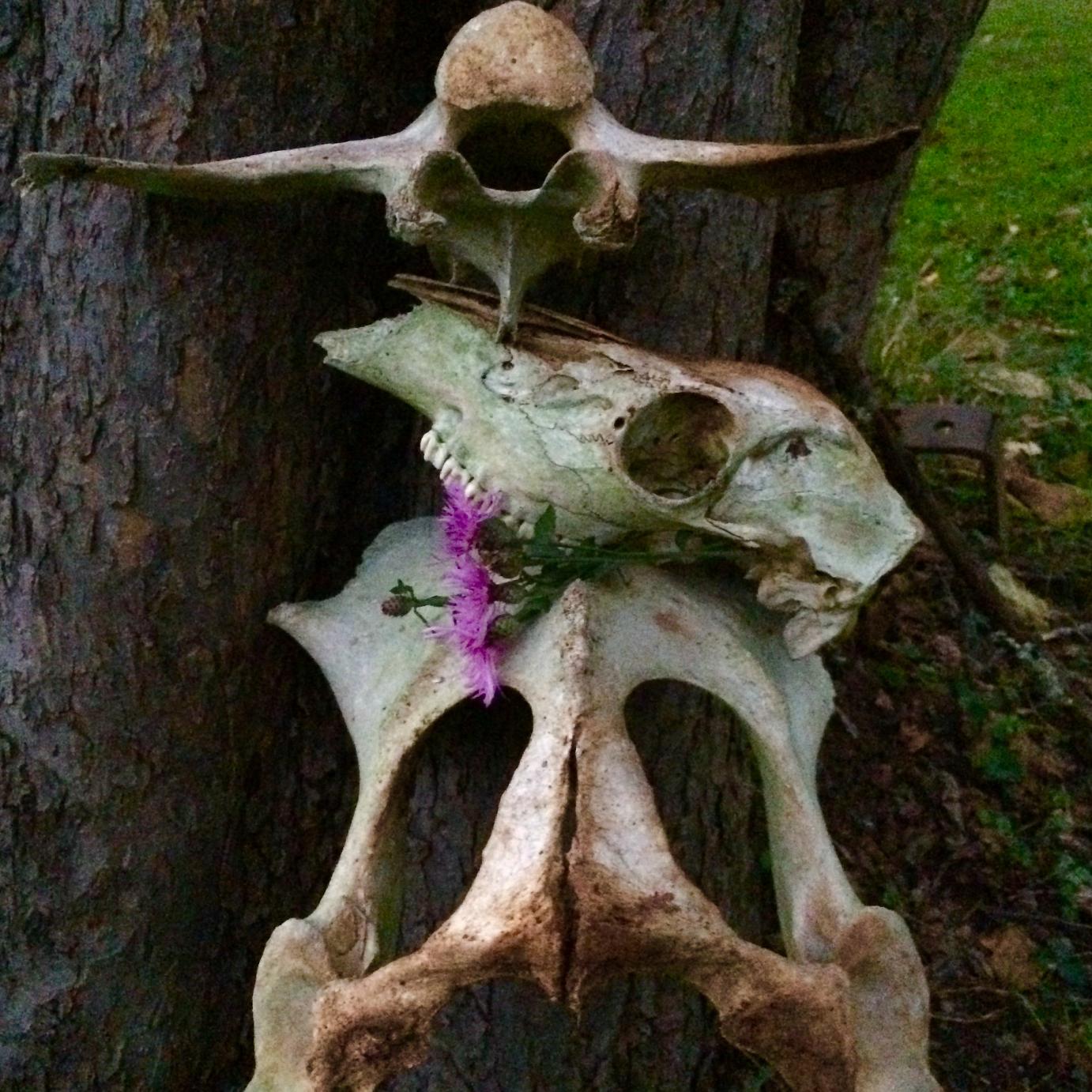 mountain, I found a cow's vertebra--its long transverse processes extended like a bird's wings--a beautiful pelvis, and a deer's skull.
It did occur to me that they have everything to do with death.
It's going to be cold tonight.
We are expecting our first hard frost.
Our herbs and late tomatoes will die.
Only the toughest wildflowers will bloom tomorrow, a few star thistles and goldenrod.
Tonight, I'll light candles in the colors of the girls.
I know when I cut the watermelon, it'll be Alexis-pink inside.
Peeling the mango, I'll see Hannah's orange.
The white cats will curl at the foot of my bed, RG's coat of arms.
Tonight I'll open a bottle of dark Cabernet and pour it into my sapphire goblet; through the crystal, by candlelight, I'll see Morgan's purple.
There are a thousand other colors also lighting up my home, sprinkled on my glass beads from India, shining on my copper-wire scorpion from Mexico, sombering my wooden Christ from Zambia, deepening my protector masks from Nepal, radiating from my Sri Lankan Buddhas.
Out my windows, in this last hour before tonight's hard freeze, a thousand miraculous tints of green play like fireworks, promising life will return.
I treasure them all with equanimity.
But I am partial, too.
I name their names and dates and colors and stories, should the girls' curtains be drawn back, and our worlds, especially on these anniversary days, be clear and open to them.
I tell them my old stories, fragile long-ago attic and dinner table moments of glass and gravy, receding in otherwise lost time, should the murdered girls be listening; in case they have time to see and listen.
Not to our guesses of what Morgan and Alexis and Hannah would do--
But instead, to our efforts which would make them happiest to see us doing.
For instance, awarding these angels, and honorary angel RG, their own fabulous letter As, none of them scarlet, punitive, or tinged by uncertainty.
These were certain girls, certain of goodness.
This is their drumroll.
Curtains open.
Morgan's A stands for Art.
RG's, for Ahimsa, profound non-violence.
Alexis', for Athleticism.
Hannah's, for Achievement and Accord.
A, as we applaud their absolute beauty, and amazing legacy.
They would smile so much to see: you already know their colors.
Jane Lillian Vance
Vice President, Help Save the Next Girl, and
Morgan Harrington's professor in the last Spring of her life