
Seven Dispatches to Mr. Jefferson
Motions Hearings in the Case of Hannah Graham and the Setting of the Trial Date in the Case of Morgan Harrington: September 30, 2015
I.
Dear Thomas,
I have artist-eyes, sensitive to details and changes.
Almost imperceptibly, just for a second, the thinning, flyaway strands behind your left ear moved today, ever so slightly. That's how I found you.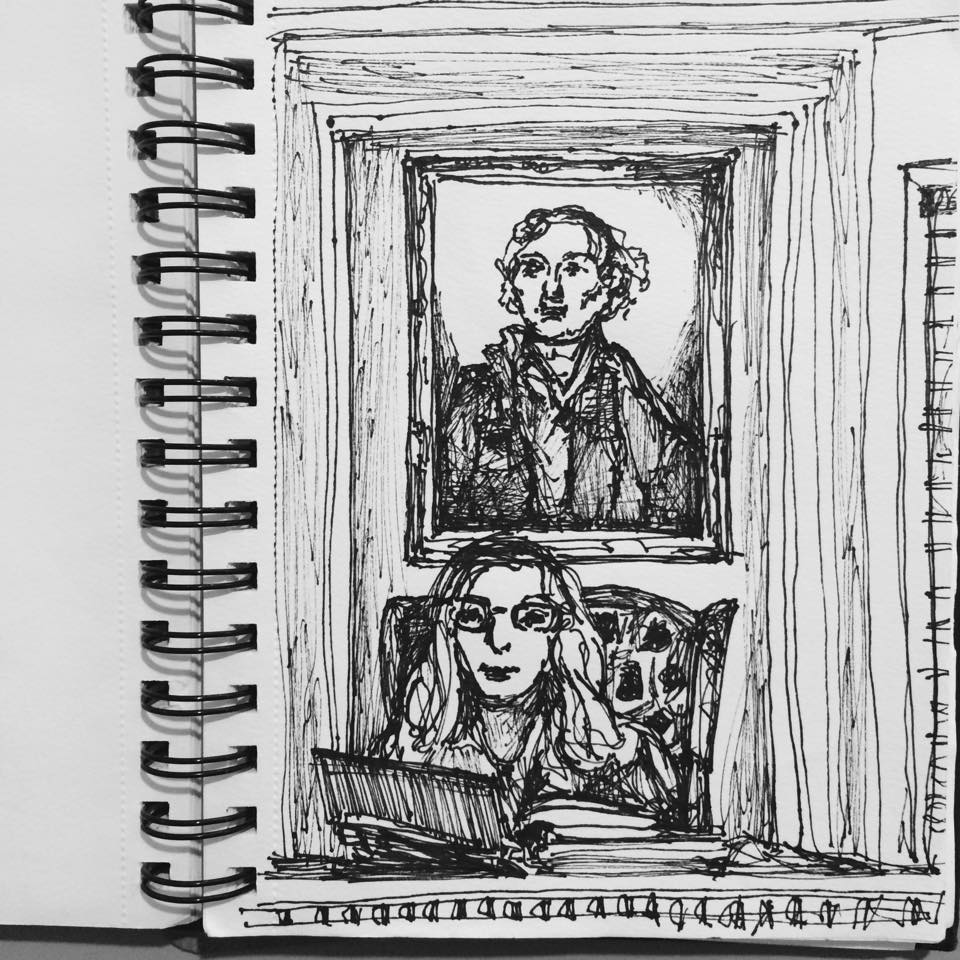
It's the cleverest place for a ghost to have hidden, in the portrait of his own countenance.
Whereas the Honorable Judge Cheryl Higgins' work required her eyes to follow Prosecutors Denise Lunsford, Carrene Walker, Matt Quatrara, and Defense attorney Doug Ramseur, and occasionally to consult her open laptop or case book, I noticed your unblinking gaze remained on Jesse Matthew and his mother.
Because of how naughty it is for you to be attending Jesse Matthew's hearings, secretly--a presidential ghost, spying, really; haunting your own old Albemarle County Courthouse--I feel liberated from formalities. So I hope it's alright that I won't be addressing you as President Jefferson.
Nothing irreverent intended. It's just that, on a first-name basis, maybe we can talk. I'd like the chance to see through your eyes. I want to think with you about the extraordinary moment we witnessed.
Jane Lillian Vance
II.
Dear Thomas,
Let me assure you that I have thought about you before today. Since we're in the Courtroom to consider a man's troubles, let me tell you what I know about yours.
Your former Vice President, Mr. Burr, my God. Scandalous, that he needed to be tried for treason. Worse, that he was a murderer. Did he really want to take over the western states, and lead an unauthorized invasion of Mexico? And did you ever think that he wanted to duel with you more than with Alexander Hamilton? If you ask me, you were lucky.
Indelicate, that you enacted the Indian Tribal Removal Act, to clear the Louisiana Purchase of indigenous people. We call that expedience genocide.
Redeeming, when you originated the Act to Prohibit the Importation of Slaves. Unlovely, though, when by day you so eloquently decried slavery, and by night, in that little room on the steep hill growing the bitter rhubarb and dark cabbages, you bedded Sally Hemings, whom you owned. And disgraceful that, for almost 200 years, the remains of your Jefferson-Hemings' descendants were denied burial near your seed-corpse.
Listing your limitations, though, I know we are all besieged by our own imperfections.
But they are nothing, a mere cloud of gnats, against the clear sky of one shining moment of pure compassion.
I'm glad you saw it happen.
I can't stop thinking about it.
Jane
III.
Dear Thomas,
The 14th Dalai Lama, the spiritual leader of Tibet, had to flee an assassination attempt in 1959.
He walked for 19 days, with fever and dysentery, over frozen rivers with wolves howling nearby, to reach the safety of the Indian border.
Thirty years later, he was awarded a Nobel Peace Prize. A quarter-century after that recognition, he is possibly the most admired person in the world.
He keeps trying to find common ground with his nation's occupiers and his personal antagonists and detractors.
He has never been able to go home.
Long trial + spiritual wisdom + resilience = what would you call it?
The Dalai Lama has said: "Non-violence takes a long time."
Maybe the best characterization of what we saw happen in court today is non-violence.
Or is it courage?
How can we name it?
As a Christian Deist, what would you call it?
Grace?
Jane
IV.
Dear Thomas,
Listen, I'm assuming you know you're dead?
I don't know how well you've followed history--I mean, what would have been the future--after your patriotic death on July 4th, 1826.
So I don't know how well you understand who the Dalai Lama is. Or Mahatma Gandhi--the little man, the non-politician, who, employing brilliant, coordinated, non-violent civil disobedience, helped long-suffering, colonized India secure her Independence from the British, on the stroke of midnight, August 16th, 1947.
I know: that was 121 years too late for you to celebrate.
Both of these men came to my mind, given what we saw in court today.
Religious figures, mystics, and warriors-turned-healers, did too: all the merciful emissaries, St. Francis of Assisi, Pope Francis, Mother Teresa, Rumi, Emperor Ashoka, Siddhartha, Jesus Christ. They all tried, or try their best, to be resilient, determined, holy.
For me, holiness is practical.
That's because the best secular behavior and the best sacred tenants always find each other and join forces. One is always becoming the other, and each is each.
And the absence of one is also the absence of the other.
Therefore, for example, if you're a jerk, you pontificate instead of teach.
You can't be both arrogant and fair.
You can't be temperamentally angry and loving.
If you are kind, you are helpful.
If you are forgiving, you heal.
And you can't be a wonderful serial rapist and murderer.
But what about being a mother, and crossing the Courtroom to lean forward and speak to the other mother, whose son murdered your daughter?
Did you, in your time, have a category for that magnitude of remarkable being?
Her name is Gil Harrington.
Jane
V.
Dear Thomas,
After Gil's daughter Morgan was murdered, she and her gentle, magnanimous husband, Dan--you saw him, Morgan's father--went to the beach where Morgan had loved to swim.
Gil told me that she realized the beach on which she was standing--which she had only ever thought of as the beach--was made of trillions of grains of broken things.
She had only seen sand before.
But now, after Morgan's murder, Gil saw that she stood on an endless stretch of impermanence. The grains were infinitesimal remains, of massive rocks, and lobster claws; of nautilus shells, and red coral; of archaeopteryx teeth, and urchin spines.
And perhaps, in the breeze, there are also infinitesimal remains, tiny fragments of distant sounds from a forgotten or undiscovered past.
Sound-sand.
Perhaps, when your Lewis and Clark reached the Pacific, having collected that fine hunk of mastodon jaw, which is still displayed at your Monticello, and so many other great fossils and artifacts for you, Kwakiutl and Lakota things, and drawings of rivers and mountains, perhaps, like Gil Harrington on the beach, they had a sense of how much had come before them which was now reduced to particles of sand.
Perhaps Lewis and Clark heard fleeting remnant notes of Tibetan cymbals and horns drifting like ghostly sound-particles from a vital culture and an unimaginably beautiful landscape, beyond even the ocean they had struggled for so long to reach.
Gil told me she was undaunted.
For her, it wasn't a depressing realization, that the sand was made of broken things.
Instead, she realized that you can leave things broken, or you can change and use them. You can meld and clarify them.
You can take sand, and make glass.
Her mind, I think, is not unlike the part of yours I admire, Thomas: the planter, the inventor, the propagator.
Jane
VI.
Dear Thomas,
All these thoughts, I hope, contextualize the main point.
Gil Harrington rose from her place on the wooden bench, facing your portrait hanging there just over Judge Higgins' head, and, against the current of all expectation, and not because of anyone's particular expectation one way or another, alone and without precedent or external guidance, she walked to stand before Jesse Matthew's mother.
I walked with her. So I saw as you saw.
Jesse Matthew's mother was still seated. She looked up at Gil. There was suffering in her face. She has a sweet face. But there was long suffering there.
Gil and I have seen that look in some of the patients we've helped in Zambia. An expression so used to difficulties that a slap would be more expected than a kindness.
Her son Jesse is charged with the murder of Gil's daughter--not his only murder charge or other horrible crime.
Gil said, face to face, and leaning in to Jesse's mother, "I realize that this is difficult for your family as well. My condolences."
And then Gil extended her hand.
I swear time stopped.
Even God gasped.
It took a noticeable pause, and in that pause, Jesse's mother glanced to the right and to the left of her, disbelieving that whoever was with her was also witnessing this moment.
And then she raised her hand.
Not as her son had done to Morgan.
Jesse's mother, in her nice brown dress, raised her gentle hand and took Gil's sweet hand.
These two women were connected for the first time.
They held one another for a few seconds.
And in those seconds, I saw Jesse's mother's face contort away from an old stoic stare into a wincing, and then finally a relieved and overcome smile.
She said, barely audibly, Thank you.
Gil returned the smile, and we walked out of the Courtroom.
Reuters, Associated Press, CBS, everyone got wind of what had just happened. Gil was walking over to speak to a hundred microphones.
But in an interstice before she did, Gil and I watched Jesse Matthew's mother walk away, receding down a side street, more slowly and more at ease than we had ever seen her leave before.
And then, when I looked back at Gil, my heart sank.
I was at first afraid.
I don't know what you ghosts can see, Thomas. Maybe you see us carry an aura or crown of emotions we don't even know we're capable of shining, abilities and feelings we don't even recognize we own. I saw something in Gil's face, mostly in her eyes. I'm not sure how often people achieve this expression.
Gil was alchemizing.
I saw the poison she had just absorbed. She had absorbed it from Jesse's mom. And as an immunization gives you a little bit of the disease to cause a reaction to it, Gil had caught Jesse's mother's agony.
I saw those moments.
I know my friend Gil, and I saw her changed with the agony of Jesse's mother. She was, for a few seconds, broken as two mothers.
And then I saw her transform that agony. She took it in, reacted to it, and was well again.
But something had changed.
Not just in Gil.
In Jesse's mother.
I think you call this alchemy a healing.
Jane
VII.
Dear Thomas,
Go back up the mountain, now.
I'm sure you sleep at Monticello, if ghosts sleep. I'm guessing, in Sally's quarters. I suspect you see now better than you could then that you actually deeply loved her.
I'm glad I spotted you today.
You would think that discovering the ghost of Thomas Jefferson hiding in a Jesse Matthew motions hearing would be my headline. But really, it's unsurprising that you were there, and really, you know what we saw.
I know in 1803 you called the Albemarle Courthouse the "Common Temple" for Charlottesville and the County. I know you hung out on the court square with James Madison and James Monroe, talking about the rights of the individual, both a Jesse Matthew and a Morgan Harrington.
The Courtroom is now listed on the National Registry of Historic Places.
But today it became more historic. For a reason I know you understand.
The Latin word taberna gives birth to two other words, both tavern and tabernacle. Taberna means shed, a place of tools; stall, a shelter for beasts; workshop, where tools forge and are forged; and pub, where joy and celebration join work. In your day, and ages before you, Thomas Jefferson, a tabernacle and a tavern were both places of sanctuary and adoration, not ironically, but brilliantly.
Intoxicating and detoxifying.
Today, the Albemarle Courthouse was all taberna, wasn't it.
Gil changed bad blood to holy wine, and sacrifice to sacrament.
Maybe you ghosts know when miracles are about to happen, and you come for the show.
Wasn't it a fine transubstantiation in the Common Temple.
Best I've ever seen.
Amen.
Love,
Jane